Where to start on a product sheet
Identify whether a dimension describes a piece, a sheet or a slab. Check the unit and record material, finish and colour separately. For slip or wear requirements, request a report that identifies the selected finish.
How to read product specifications
A product page records the name, form, dimensions, thickness, material, finish, colour and application imagery. Check whether the entry describes a finished product, a sample or a fitting before comparing figures in the same units.
Name & model
Save the product link. Similar names can cover different formats, so include the chosen size when requesting a sample.
Product form
Identify the unit supplied: an individual piece, a sheet, a slab or a fitting. Compare it with the unit in the quote.
Dimensions
Identify the part being measured, then record its length, width and unit together.
Thickness
Find the thickness for the format you intend to order. At an edge or floor junction, ask for the corresponding cross-section.
Material
Read the named material. A stone pattern you like can be made in several materials.
Finish
Note the finish, then request a sample or a technical report for that particular surface.
Colour
Compare samples under the same light and record your selected colour on the enquiry.
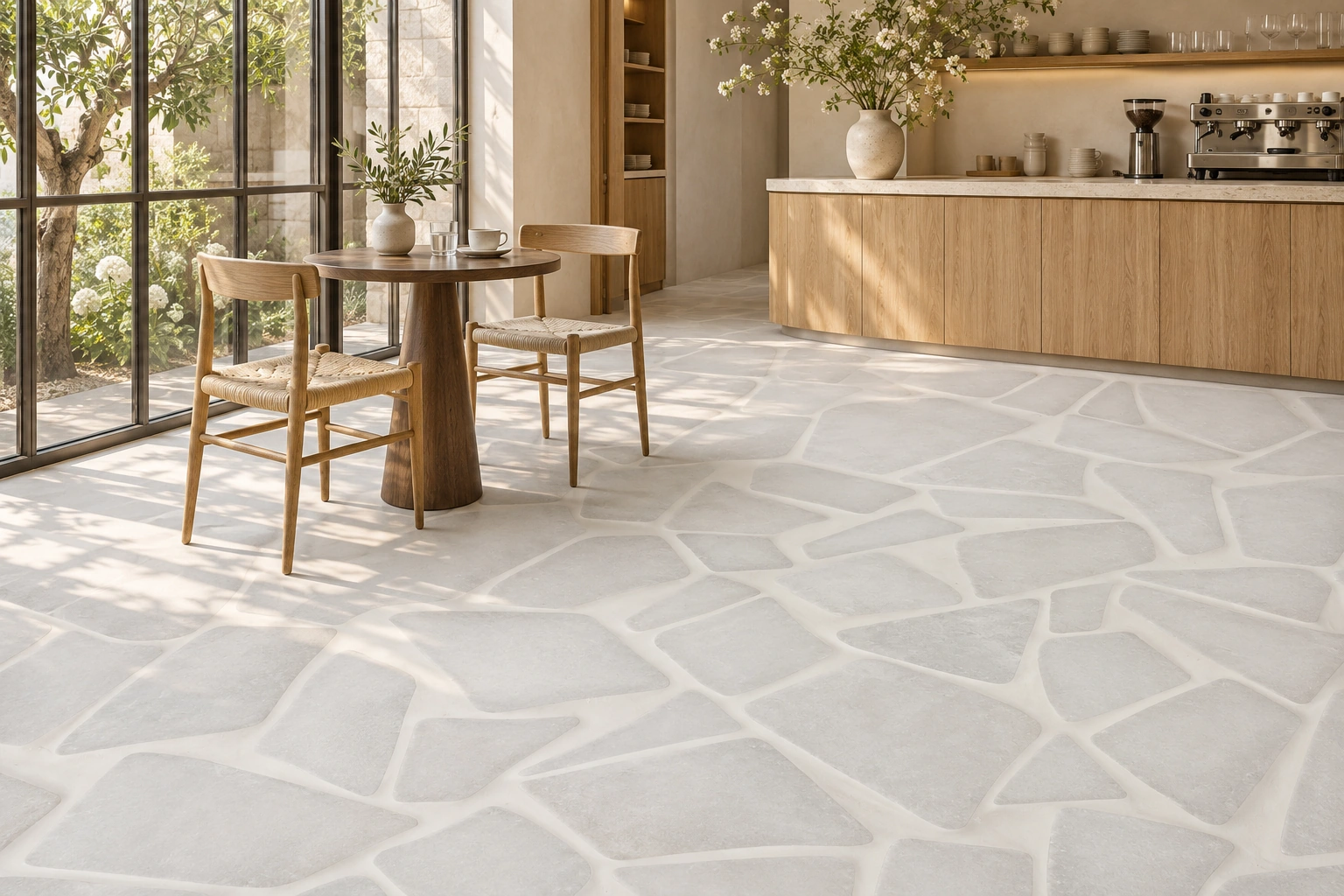
Application views
Use a room view for scale and direction of the pattern. Check colour and detail against a photograph or sample of the actual product.
How do you compare two materials?
One set of dimensions may describe a single tile, another a sheet of mosaic. Four examples from the catalogue show how to read a finish, identify a material, compare sizes and request a quote from a sample.
What does a finish name tell you?
Terms such as matt or textured describe aspects of a product’s surface. Compare the wording alongside images and information for the particular item.
This patterned ceramic tile is listed at 500 × 500 × 9.5 mm with a dry-granule finish. Those details identify the sample to request. For a floor that is frequently wet, ask for slip-test information covering the selected finish and intended conditions.
Stone patterns, natural stone and panels
A stone pattern describes an appearance; natural stone and other panels refer to material categories. Similar-looking entries may still represent different product forms.
This black cut-to-size piece is listed as natural limestone, 150 × 150 × 15 mm. Cut-to-size describes its form and limestone its material. When comparing a similar stone-look tile, record both materials, thicknesses and edge details.
Compare dimensions on the same basis
Record what a dimension measures, its unit and the product form. Piece, sheet, panel and pattern dimensions should not be treated as interchangeable.
This glossy blue-grey mosaic lists a 100 × 100 mm chip and a 306 × 306 × 13 mm sheet. The chip size describes the pattern at close range. The sheet dimensions describe the supplied assembly. Ask whether the quote is per sheet, box or square metre and how many sheets each box contains.
Distinguish samples from product entries
The catalogue includes products as well as sample designs, pattern templates and component pieces. A sample can illustrate colour or a combination, but it has a different role from a complete product entry.
This sand-brown grid sample shows the pattern and colour. Its material is listed as cement and its size still needs confirmation. Ask whether the quote covers a sample, one component or the full composition, and request its dimensions, selling unit and list of included pieces.
Applications

Wall & floor tiles

Slabs & large formats

Wood-look tiles